Digital tool improves mobility and balance in people at risk of falls

Digital tool improves mobility and balance in people at risk of falls image

Home » News » Digital tool improves mobility and balance in people at risk of falls

The largest real-world evaluation of GaitSmart, an AI-driven digital tool for people with gait (walking pattern) and mobility issues across four sites in Bedfordshire, Luton and Milton Keynes, has seen improved health outcomes and positive feedback.

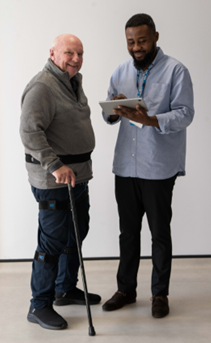
A man with an NHS lanyard writes something on a pad while he talks to an older man, who is using a walking stick and wearing some electronic sensors. They are fixed to his trousers above and on his knees, and on his ankles.
Benson Owusu, Care Coordinator at West Street Surgery in Luton, using GaitSmart to assess the walking pattern of one of his patients.

Using wireless sensors, GaitSmart records an individual’s movements as they take just 10 to 15 steps. In minutes, the system compares the readings to ‘healthy’ gait profiles and suggests interventions and exercises to improve strength, stability or balance – reducing their risk of a fall.

GaitSmart supports the three major shifts outlined in the NHS 10-Year Plan by delivering digital, preventative care in communities rather than in hospitals. It had been proven to be clinically effective and is recommended by the National Institute for Health and Care Excellence (NICE), however implementation experiences and outcomes had not previously been explored across different settings.

Over a 15-month pilot funded by NHS England, the Digitising Social Care programme in Bedfordshire, Luton and Milton Keynes Integrated Care Board (BLMK ICB) trialled GaitSmart in primary, secondary, and community care settings. Health Innovation East was commissioned to evaluate uptake, clinical outcomes, and user experience.

Participants typically completed four tests over 12 weeks, allowing progress to be monitored and exercise plans adjusted. 272 individuals completed the first test, of which 184 were able to complete the four-test protocol within the evaluation period.  Of these 98 completed the fourth during the evaluation period.

  • Improved clinical outcomes: 90% of the patients improved in at least one measure, while 48% improved in all four outcomes (GaitSmart score, gait speed, stride duration and joint angle).
  • Positive patient experience: 92% of patients who answered a survey would recommend GaitSmart to others experiencing walking or rehabilitation difficulties, and 76% reported some or significant improvement in their mobility. They reflected that GaitSmart improved their daily life, was easy to understand, and gave them increased motivation to exercise.
  • Varied staff feedback across the different settings: 50% of staff who conducted tests and responded to a feedback survey agreed that GaitSmart should be continued in their service, 25% neither agreed nor disagreed and 25% disagreed.
  • Understanding uptake: A range of factors was found to influence uptake and drop off between tests, such as patients feeling reassured by a high initial GaitSmart score, as well as individual characteristics such as mobility levels, overall health, and pre-existing conditions. This has informed a number of recommendations for the future implementation, adoption and spread of GaitSmart.

Clare Steward, Digitising Social Care programme director for Bedfordshire, Luton and Milton Keynes Integrated Care System, said:

“The real-world testing of new technologies such as GaitSmart is a vital stage in developing them, allowing us to gauge patient and staff feedback, as well as the clinical benefit. I’m delighted to see that we’ve been part of this successful evaluation process, and I know that GaitSmart will continue to benefit patients.”

Health Innovation East and BLMK ICB acknowledge the contributions of GaitSmart and the four pilot sites, whose involvement was instrumental to this work. Several of the sites in BLMK will continue using GaitSmart until at least March 2026.

To find out more about the Bedfordshire, Luton and Milton Keynes Digitising Social Care programme, visit https://blmkhealthandcarepartnership.org/about/our-priorities/data-and-digital/digitising-social-care-disc-programme or contact the team on blmkicb.digital.socialcare@nhs.net.

View all news

Latest news and highlights

News

1 December 2025

Digital records support care providers to work more efficiently and deliver more…

A project to support care providers in Bedfordshire, Luton and Milton Keynes to adopt digital records has achieved all its planned objectives and demonstrated an…

News

14 November 2025

Local NHS preparing for strike action

The doctors’ union the British Medical Association has announced that resident doctors across the country will be taking industrial action for five days, after national…

News

14 November 2025

New support for cancer patients across Bedfordshire and Milton Keynes launched

Bedfordshire, Luton and Milton Keynes Integrated Care Board (BLMK ICB) has launched a new suite of informative videos designed to support patients, families and carers throughout their cancer care journey.…

News

10 November 2025

Flu jab SOS for residents in the East of England with worst…

The NHS has issued a ‘flu jab SOS’, with the East of England’s vaccinations expert warning people to get protected now, with only weeks to go before the worst of the…

News

31 October 2025

Local general practices offer more appointments than the same period last year

The number of appointments available at general practices in Bedfordshire, Luton and Milton Keynes has shown a further increase. Figures published by NHS England reveal that over 1,650,000 appointments were…

Case Study

27 October 2025

Innovative facial analysis app recognises pain in care home residents

Danecroft is a 34-bed care home in Bedford, predominantly caring for people living with dementia but also other conditions such as Parkinson’s and MS. Since April, it has been using…